Wednesday, July 31, 2019

                       WARLIGHT   [AKASH NS]


The term warlight was used to describe the dimmed lights that guided emergency traffic during London's wartime blackouts. The word aptly describes the atmosphere of this haunting, brilliant novel from Ondaatje (The Cat's Table), set in Britain in the decades after WWII, in which many significant facts are purposely shrouded in the semidarkness of history. The narrator, Nathaniel Williams, looks back at the year 1945, when he was 14 and "our parents went away and left us in the care of two men who may have been criminals." Nathaniel and his older sister, Rachel, are stunned to discover that their mother's purported reason for leaving them was false. Her betrayal destroys their innocence; they learn to accept that "nothing was safe anymore." To the siblings' surprise, however, their designated guardian, their upstairs lodger, whom they call the Moth, turns out to be a kind and protective mentor. His friend, a former boxer nicknamed the Pimlico Darter, is also a kindly guide, albeit one engaged in illegal enterprises in which he enlists Nathaniel's help. The story reads like a nontraditional and fascinating coming-of-age saga until a violent event occurs midway through; the resulting shocking revelations open the novel's second half to more surprises. The central irony is Nathaniel's eventual realization that his mother's heroic acts of patriotism during and after the war left lasting repercussions that fractured their family. Mesmerizing from the first sentence, rife with poignant insights and satisfying subplots, this novel about secrets and loss may be Ondaatje's best work yet

The Devil and Miss Prym (Book Review) - S R Santhini

    From the age of reason to this moment, the aspect of 'Good and Evil' is always a burning issue in humankind. Through the novel 'The Devil and Miss Prym' Paulo Coelho gives us a range of fulgurant thoughts regarding this clash between good and evil inside everyone.
The stranger who has been a business man comes to a small village called Viscos  after the tragic experience of losing his family in a merciless murder. His motive was to know whether good or evil exists. He is offering ten gold bar to the village as the reward for a murder and a gold bar to Miss Prym who was being used by him to proceed his game.  Then on the conflict between greed and goodness of Miss Prym, who has been dreaming of leaving the village and living a luxurious life but still loves her village much, began. She somehow let the people know about the offer made by the stranger. Thereafter the writer makes us very anxious to see how the good or evil succeeds in such a battle.  Another thing he implicitly conveys is that people always try to make excuses to justify their own acts of rightness and wrongness. Here the coward village people also find such an excuse not only to get the gold bars but also to expose themselves still good.
The other characters like Berta and the Priest too help give some insights throughout the story. The story, within the story, of Ahab striked me much. It tells us that even in a worst or most cruel person, we can figure out virtues. 
      
 Really loved the book. It was not merely a journey through the most beautiful village but a fictional journey  through the world where still good and evil fight together to make the good succeeded at last.....as Paulo Coelho, my favorite writer, says "Evil had to manifest itself and fulfil its role, so that ultimately Good could prevail.”
                                                                                                              WARLIGHT                                                                                                                                                       The term warlight was used to describe the dimmed lights that guided emergency traffic during London's wartime blackouts. The word aptly describes the atmosphere of this haunting, brilliant novel from Ondaatje (The Cat's Table), set in Britain in the decades after WWII, in which many significant facts are purposely shrouded in the semidarkness of history. The narrator, Nathaniel Williams, looks back at the year 1945, when he was 14 and "our parents went away and left us in the care of two men who may have been criminals." Nathaniel and his older sister, Rachel, are stunned to discover that their mother's purported reason for leaving them was false. Her betrayal destroys their innocence; they learn to accept that "nothing was safe anymore." To the siblings' surprise, however, their designated guardian, their upstairs lodger, whom they call the Moth, turns out to be a kind and protective mentor. His friend, a former boxer nicknamed the Pimlico Darter, is also a kindly guide, albeit one engaged in illegal enterprises in which he enlists Nathaniel's help. The story reads like a nontraditional and fascinating coming-of-age saga until a violent event occurs midway through; the resulting shocking revelations open the novel's second half to more surprises. The central irony is Nathaniel's eventual realization that his mother's heroic acts of patriotism during and after the war left lasting repercussions that fractured their family. Mesmerizing from the first sentence, rife with poignant insights and satisfying subplots, this novel about secrets and loss may be Ondaatje's best work yet             


                                (Submitted by :AKASH NS)

The Symbols in the story Sparrows by K.A Abbas - Anirudh S Bhaskaran

The story Sparrows by K.A Abbas (1914-1987) , is one that requires much more than just surface-level reading. It is a story, which thoroughly makes use of its setting, events and characters to convey a touching and intimate side to a misunderstood farmer, Rahim Khan, who is despised and cast out from society due to his insolent and savage exterior. There are many instances in this story which can be considered as a symbol and these are a few noteworthy ones.

1, The Setting Sun
"The sun was setting behind the mango grove which fringed the western extremity of the village when Rahim Khan returned from the fields"

- The story begins with a seemingly simple line which when read at a glance, conveys nothing more than the environment in which the story takes place. However, just as a Rising Sun is metaphorically seen as victory and hope (Just like the what the flag of Japan symbolises), the Setting Sun gives the reader a rather small idea that the story deals with the decline and impending death of the character, that is, Rahim Khan.

2, The Plough
"Broad and strong despite his fifty odd years, with his plough on his shoulders, and driving his two oxen, he walked through the village with a haughty and unfriendly air"

- All his frustrations, unfulfilled dreams and hatred of certain people in his life, have all pent up into this massive burden that he carries throughout his life. His dream of travelling with the Circus was shut down by his parents as they felt it was "too lowly" and "immoral" for a "respectable peasant". This along with his desire to marry a girl of his choice, Radha, was quashed as she was a Hindu and to do so would be "irreligious"

3, The Hut
"The subject of their conversation, meanwhile, had reached his hut which, almost symbolically, stood gaunt and aloof, at a distance from the neighbouring cluster of houses" 

"Seething with inward wrath he entered the dark hut and sat down on the charpoy"

- The hut symbolises Rahim Khan himself. It shows how he has been excluded and alienated from society and how people avoid him at all costs. It points to how he has been deserted by his wife and two sons and there is almost nothing but darkness inside. All the pain he inflicted upon his family in that very hut, is the same he suffers within. He finally dies inside the very same hut, consumed by all the bitterness and darkness with a sliver of virtue. 

4, The Cobwebs
"In a corner they revealed some cobwebs and, having already decided to absent himself from his fields, he thought he would tidy his hut"

- The cobwebs refer to the past that has enwrapped him and made him the person he is today, concealing the true man his deep below. The sun streaming in through the open window as mentioned in the line prior to this, showcases that a ray of positivity has found its way into the "dark" hut. His decision to clean up the cobwebs is a symbol that he is ready to move on and turn over a new leaf and not let his bitter and disappointing past define who he is as a person today.

5, His Wife and Children

- He sees his family as objects to vent out his anger and to carry out his vengeance. His wife is referred to as "a necessary piece of furniture" and is described to have been waiting for him on their wedding day as "a sheep awaits the butcher". It highlights a patriarchal society that women live in and the abuse they sustain. his children also fall victim to his rage and run away, eventually followed by their mother. Rahim Khan's family was the only part of his life that added any sort of sustenance to his life and once that had escaped his clenches, he began introspecting. But by then, he was thirty years too late.   


5, The Sparrows 

- The very title of the story. Sparrows signify a sense of community and happiness. Rahim Khan observes the family of sparrows and learns the true meaning of family. He is drawn to the birds and even goes on to the name the young ones after his very own children, Nuru and Bundu. He views the family as his own and the nest as what his house could have been, a home. The manner in which the sparrows takes care of their young ones teaches Rahim Khan the essence of being a parent and husband. His act of saving the nest from the rain is proof of this as he is now no longer the man that he was.


Tell me your dreams- Sidney Sheldon (By Ann Lopez)


         Tell me your dreams is a novel written by American writer Sidney Sheldon, and was published in 1998.

      The first part of the book tells about 3 women, Ashley Patterson, Antonette (Toni) Prescott and Alette Peters. Toni and Alex seems to know each other and Toni has a dislike for Ashley because of her shy and introverted nature. Towards the end of the first part it is revealed that Alette and Tony are alters of Ashley who suffers from multiple personality disorder or M.P.D.
who arose as a result of the experiences Ashley had to face from her father, Dr. Steven Patterson. Ashley is convicted for the murder of the Deputy who was at her house for investigation. The second half deals with Ashley's trial and how her lawyer convinces the Attorney of her condition and how her doctor helps her overcome her condition and the hatred for her father.

           This is a very interesting book Sheldon is successful in taking us on a tour through the mind of a person suffering from MPD, the challenges she has to face and how she overcomes it.
     
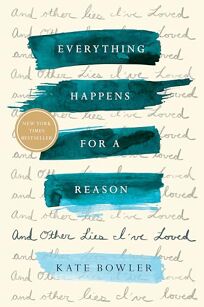
Everything Happens for a Reason and Other Lies I’ve Loved
EVERYTHING HAPPENS FOR A REASON- KATE BOWLER 
by Bijoy

With grace, wisdom, and humor, Bowler (Blessed), a divinity professor at Duke University, tells of her cancer diagnosis and subsequent treatment in a way that pierces platitudes to showcase her resilience in the face of impending death. At 35 years old, after months of enduring stomach pains and visiting specialists who had conflicting suggestions, Bowler was rushed into emergency surgery for stage IV colon cancer. Surrounded by her husband, very young son, and a host of supportive friends, she faces down the likelihood that she will not live a year. As she responds well to treatment, she enters a period of uncertainty, hoping to survive and maximize her time with her family. Throughout her account of weekly flights to Atlanta from North Carolina for experimental therapy and realizations that each holiday might be her last, she relates her suddenly terrifying life to her academic work on the prosperity gospel—a peculiarly American belief in deserved success and control that is at odds with her current life. Bowler’s lovely prose and sharp wit capture her struggle to find continued joy after her diagnosis. This poignant look at the unpredictable promises of faith will amaze readers.

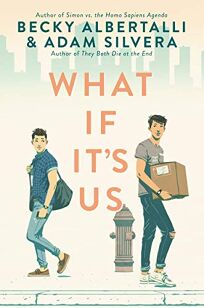
 What If It's Us                          by atul
Authors Albertalli (Simon vs. the Homo Sapiens Agenda) and Silvera (They Both Die at the End) team up for a charming, sweet-natured love story between two very different boys. Arthur (written by Albertalli) is in New York for the summer while his lawyer mother works a big case. His family’s affluent and Jewish, and he’s a Broadway geek and a virgin with good grades. Native New Yorker Ben (Silvera) is Puerto Rican. His family’s on a tight budget, he’s just out of a relationship, and he’s stuck in summer school. Arthur believes in love at first sight; Ben’s not even sure he believes in love. After they bump into each other at a post office, then are separated by a flash mob, Arthur searches the New York haystack to find one adorable high school junior. But the course of meet-cute never did run smooth: complications include friends, Ben’s ex, cultural differences, and the difficult and confusing nature of love. The authors—one known for happy endings, the other for breaking hearts—split the difference believably, and it’s impossible not to root for Arthur and Ben and their many do-overs. Ages 14–up.